
The cut-off rule, exactly
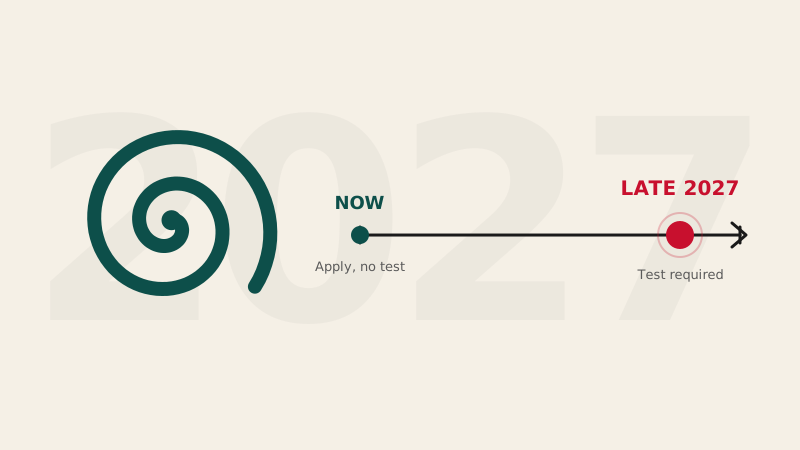
The Department of Internal Affairs has confirmed that the test will apply to citizenship-by-grant applications from the second half of 2027. Anyone who applies before the test becomes a requirement will not have to sit it. The exact go-live date hasn't been published yet, but it's somewhere in the second half of 2027.
The rule is straightforward: it's the date you submit your application that counts, not the date your decision is issued. If your application lands a few weeks before the cut-off and is processed months later, you still won't need to take the test. Conversely, if you submit even a day after the cut-off, the test is required.
The test replaces the existing declaration that applicants currently sign about understanding the responsibilities and privileges of citizenship — it does not replace any other requirement. If you don't meet the residence, character, or English requirements, applying early won't help.
Are you actually eligible right now?
Whether the cut-off matters to you depends on whether you're already eligible to apply. The basic requirements for citizenship by grant haven't changed:
- Residence visa for at least 5 years — usually a permanent resident visa, but other resident visas count
- Presence in NZ for at least 240 days in each of those 5 years, with a total of at least 1,350 days
- Functional English — sufficient to handle everyday life and basic interactions with government
- Good character — no recent serious offences, with various tests applied to specific situations
- Intention to continue living in New Zealand — not a strict commitment, but a relevant factor
If you don't meet these basics, the test cut-off is not your most pressing concern. Focus on building eligibility cleanly, and treat the test as a routine future step.
The case for applying now
For applicants who clearly meet the requirements and have their documents in order, applying before the cut-off is genuinely worthwhile.
You skip the test entirely — no study time, no fee per attempt, no in-person attendance, no risk of a bad day. Even with the high pass rates seen in comparable countries (typically over 90%), the test is friction. Once you're a citizen, the rules behind you no longer matter — future fee changes, future test changes, future eligibility changes can't reach you.
There's also a queueing argument. DIA processes citizenship applications in waves; application volumes typically spike around major rule changes. Submitting early avoids being caught in the surge of last-minute applicants in the months immediately before the cut-off.
The case for waiting
For applicants who aren't yet ready — incomplete documentation, character issues that need to age out, residence days still being accumulated — rushing is a worse strategy than waiting.
Rushed applications make mistakes. Mistakes cause refusals. A refused application is more damaging than a delayed one — it goes on the record, and you only get a partial refund of the fee. The test, by contrast, is a manageable additional step for most people: it's in English, it covers a finite syllabus, and you get up to six attempts.
A clean application submitted six months after the cut-off is far better than a sloppy application submitted six weeks before it. If you're missing documents, if your residence days are tight, if your character record has open issues — fix those first, then apply when you're ready.
Edge cases worth thinking about
You're close to eligibility (4 to 5 years residence)
If you'll cross the 5-year threshold sometime in 2027, the question is whether to apply on the day you become eligible (which may be just before the cut-off) or wait a bit longer. The answer is almost always to apply on the day you become eligible — there's no reason to delay further, and the cut-off pressure adds a small extra reason to file promptly.
Family applications with mixed eligibility
If you and a partner became permanent residents at different times, one of you may be eligible to apply now and the other not. The eligible person should generally apply now, independently — there's no benefit to waiting for the other to catch up. When the second partner becomes eligible, they apply separately, regardless of where the cut-off falls.
Children
Applicants under 16 are exempt from the test. Children can apply at any time — before or after the cut-off — without the test affecting them. There's no urgency on their behalf.
Applicants over 65
Also exempt from the test. The cut-off is irrelevant for over-65 applicants. Apply when ready.
Citizenship by descent or birth
Neither pathway involves the test. The cut-off only affects citizenship by grant.
A simple decision framework
Three questions, in order:
- Are you currently eligible? If no — wait until you are. The test isn't your problem yet.
- Do you have a complete, clean application ready to submit? If no — fix the gaps first, then apply. The test (around NZD $24 per attempt, six attempts allowed) is far cheaper than a refused application.
- Do you have the time and documents to file before the cut-off? If yes — apply now and skip the test entirely. If no — apply when you're ready and treat the test as a routine future step.
What to do next
- Use the official eligibility self-check tool to confirm your status
- Read the complete guide to the new test if you're likely to need to take it
- Gather your documents — for most applicants, this is the bottleneck rather than the rules themselves
- If you decide to wait, join our waitlist below for the official study guide and our practice platform when DIA releases study materials
This article is general information, not legal or immigration advice. For your specific situation — especially if you have a complex residence history, character matters, or unusual family circumstances — consult a licensed immigration adviser or DIA directly.