
A quick recap
The Department of Internal Affairs has confirmed that, from the second half of 2027, applicants for citizenship by grant will need to pass a multi-choice test. The test has 20 questions, a 75% pass mark (15 of 20 correct), runs in English, and lasts up to 45 minutes. Up to six attempts are allowed.
If that's all you wanted to know, the complete guide to the test covers the policy in detail. This article focuses on what the experience will likely feel like in practice — booking, the day itself, the 45 minutes, and what happens after.
DIA has confirmed the high-level format but many operational details — exact test centres, fees, accessibility accommodations, whether the result is instant — are still being finalised. Where this article describes specific procedures, we say whether DIA has confirmed them or whether we're inferring from how comparable tests work in Australia and the UK.
Booking the test
DIA has indicated that the test will be delivered in person at test centres located throughout New Zealand, not only in Auckland, Wellington, and Christchurch. The exact list of centres has not yet been announced — this will likely come closer to the late-2027 launch date.
Based on the procurement tender and how Australia and the UK run their equivalent systems, you can expect the booking process to look like this:
- Receive an invitation from DIA to book the test, after the test component of your citizenship application is queued for processing.
- Book online through a designated portal, choosing a centre and an available time slot.
- Pay the test fee at the time of booking. The fee has not been finalised; the procurement tender referred to a per-test cost of NZD $24, but this could change.
- Receive a confirmation with your booking details and any preparation guidance.
Slot availability will likely depend on demand. In Australia, busy centres in major cities can have waits of 2-4 weeks for the next available slot, while smaller centres are typically faster. NZ should be similar at launch, with availability tightening if demand spikes — for example, in the months immediately after the test goes live.
What to bring on the day
DIA hasn't published a definitive list yet, but based on Australia and UK practice, expect to need:
- Government-issued photo ID matching the name on your booking — passport, NZ driver's licence, or NZ-issued ID card
- Your booking confirmation — printed or shown on your phone before you put it away
- Time to spare — arrive 15-30 minutes early to handle check-in and any last-minute admin
What you can't take into the test room (again, based on comparable systems):
- Phones, smartwatches, or any connected devices — these will need to be locked away or left at reception
- Notes, books, or printed study materials
- Bags or coats — usually stored in a locker
- Food or drink, beyond what the centre provides (often water at the workstation)
The test environment
The procurement tender confirms that the test will be delivered digitally — meaning you'll be working on a computer or tablet, not pencil-and-paper. The likely setup, based on how Australia and the UK run their tests:
- A small, quiet test room with several workstations separated by partitions
- An assigned computer or tablet running the test interface, with a clear screen layout
- A staff member available for technical issues, but not for content questions
- A photo or signature check before the test starts, to confirm you are the person who booked
- A short tutorial on how the test interface works — how to navigate, flag questions, and submit — before the timer begins
The cheating-prevention measures specified in DIA's tender suggest that workstations will be separated from each other, screens will not be easily visible to neighbours, and there may be some form of monitoring during the test. This is standard for any modern in-centre civic test.
The 45 minutes
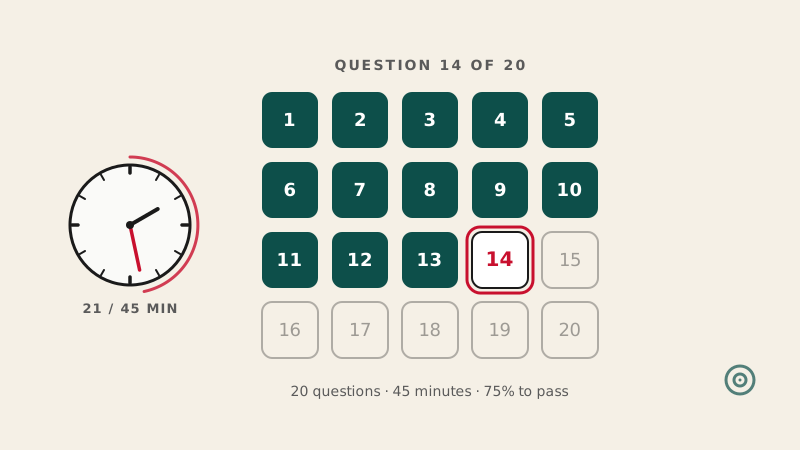
Twenty questions in 45 minutes works out to 2 minutes 15 seconds per question on average. That's far more time than you'll need for most multi-choice questions. Don't rush.
The expected interface (based on Australia, UK, and the digital tender):
- One question on screen at a time
- Three or four answer options per question
- "Next" and "Previous" buttons to move through the test
- A "flag for review" option to mark questions you're unsure about
- A summary screen near the end where you can see your answers and revisit flagged ones
- A final submit button — once you submit, the test is complete and locked
Pacing tips
- Read each question fully before looking at the answers. Multi-choice questions sometimes turn on a single word — "first", "always", "not" — and skim-readers miss it.
- If you're unsure, flag and move on. Don't burn five minutes on one question. Easier questions later in the test deserve your attention more than a stuck question now.
- Save 5-10 minutes at the end for review. Use that time to revisit anything you flagged.
- Don't change answers on review unless you have a specific reason. Research consistently shows your first instinct is more often right than your second-guess.
Getting your result
DIA hasn't yet confirmed whether results are issued instantly or after a short delay. The digital format of the test makes instant on-screen result the most likely outcome — that's the standard for digital civic tests in Australia, the UK, and most US naturalisation contexts. But this is inference, not confirmed.
What you'll want to know:
- Whether you passed (yes/no) — almost certainly on screen at the test centre
- Your score, if disclosed — practice varies; some systems disclose, others only confirm pass/fail
- What happens next — typically a confirmation that the test component is complete, with the rest of your citizenship application proceeding through normal DIA processing
If you pass, the rest of your citizenship application moves forward in the normal queue. The test result alone doesn't grant citizenship — DIA still has to approve the full application, after which you attend a citizenship ceremony.
If you don't pass
The 6-attempt structure works as follows, based on what DIA has confirmed:
- Attempts 1-3: take the test, rebook if you don't pass. There's no mandatory waiting period between these three attempts beyond booking availability.
- Mandatory wait: at least 30 working days (about six weeks) before you can try again, after the third unsuccessful attempt.
- Attempts 4-6: three further attempts, again with no mandatory wait between them.
- After 6 unsuccessful attempts: you're referred back to DIA. Options include withdrawing your citizenship application (with a partial fee refund) or asking the Minister of Internal Affairs to consider the application directly.
Each attempt will likely require its own fee. If the indicative $24 figure holds, six attempts would cost up to NZD $144 in test fees alone. For most applicants this is manageable — but it's worth budgeting for, especially if your English is not strong or you haven't had time to study.
The good news: comparable countries report pass rates above 90%, with most applicants passing on their first attempt. The six-attempt structure is a generous safety margin, not a likely outcome.
Common mistakes to avoid
Drawn from how applicants trip themselves up on the Australian and UK tests:
- Assuming the test is easier than it is. Pass rates are high, but they're high for prepared applicants. The test isn't a formality — it covers a real syllabus and rewards real study.
- Studying only your strongest topic. The test draws from all six topic areas. Weakness in any one (especially Bill of Rights or government structure) costs you, because there's no way to "skip" a topic on test day.
- Cramming the night before. Citizenship tests reward steady familiarisation, not last-minute memorisation. Distribute your study over weeks, not hours.
- Misreading questions. Multi-choice format is tricky when you skim. Read the full question and all options before choosing.
- Skipping the review. If you finish with time to spare, use it. Coming back to flagged questions with fresh eyes catches errors.
- Letting nerves get in the way. The test is just 20 questions, in a quiet room, with up to six attempts. Treat it like a routine appointment, not a high-stakes oral exam.
What we still don't know
DIA has not yet confirmed:
- Whether results are instant or delayed
- The exact list of test centre locations
- The final booking fee
- Whether accessibility accommodations (extra time, screen reader, sign language interpreters) will be available — DIA has said they'll consider exemptions and accommodations, but specifics are pending
- The precise weighting of the six topic areas — whether some count for more questions than others
- Whether re-attempt fees are reduced or full price
All of these are expected to be announced before the test goes live. We'll update this article as DIA publishes more detail.
What to do now
If you're going to need to take the test:
- Familiarise yourself with the six topic areas
- Watch for DIA's release of official study materials
- If you're close to citizenship eligibility now, consider whether to apply before the test becomes mandatory
- Join our waitlist below for the official study guide and our practice platform when DIA publishes the materials
This article is general information, not legal or immigration advice. Operational details about the test will be confirmed by DIA before the late-2027 launch. For your specific situation, consult a licensed immigration adviser or DIA directly.