The short version
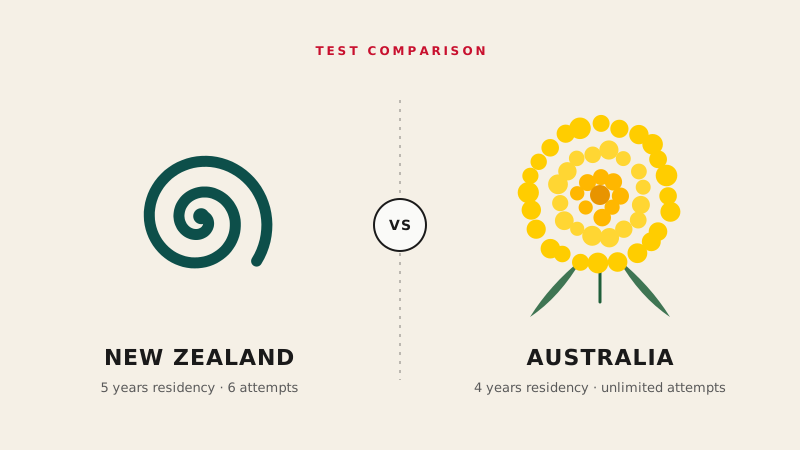
The two tests are structurally similar — same length, same pass mark, same in-person digital format, both drawing from a closed question pool. Where they differ:
- Australia adds a "values" supplement — five questions you must answer 100% correctly, in addition to the 75% overall pass mark.
- Australia allows unlimited attempts; NZ caps at six.
- Australia publishes its study booklet ("Our Common Bond") openly; NZ's official study materials are still being prepared.
- Australia's age exemption starts at 60; NZ's at 65.
Beneath the test, the citizenship pathways themselves differ more. NZ requires five years of residence; Australia requires four. NZ counts physical presence days strictly; Australia is more flexible. NZ is roughly NZD $100 cheaper than Australia once test fees are included. The full side-by-side is below.
Side-by-side comparison
| Feature | New Zealand | Australia |
|---|---|---|
| Test goes live | Late 2027 | Already in operation (since 2007) |
| Number of questions | 20 | 20 |
| Time limit | 45 minutes | 45 minutes |
| Pass mark | 75% (15 of 20) | 75% overall + 100% on 5 values questions |
| Question pool | Closed (likely) | Closed |
| Study materials | Pending — DIA to publish before launch | "Our Common Bond" booklet, free, online |
| Format | In-person, digital | In-person, digital |
| Language | English only | English only |
| Maximum attempts | 6 | Unlimited |
| Age exemption | Under 16, 65 and over | Under 16, 60 and over |
| Residency requirement | 5 years as resident | 4 years lawful residence + 12 months as PR |
| Physical presence | 240 days/year, 1,350 total over 5 years | Max 12 months absence in 4 years, max 90 days in last 12 |
| English requirement | Functional English (separate from test) | Tested via the citizenship test itself |
| Application fee | ~NZD $470 + test fee per attempt | AUD $560 (test included) |
| Dual citizenship | Allowed | Allowed |
| Citizenship ceremony | Required | Required (with pledge) |
The tests themselves
Structure
The two tests are functionally near-identical. Both deliver 20 multiple-choice questions in 45 minutes, drawn from a confidential question bank, on a computer at a designated test centre, in English. Both require 75% to pass. Both are self-funding — applicants pay for the test as part of the broader citizenship application.
The biggest format difference is Australia's values component. Five of the 20 questions are designated as "Australian values" questions — covering principles like freedom of speech, equality of men and women, mutual respect, and rule of law. Applicants must get all five values questions correct in addition to the 75% overall pass mark. Getting four out of five values questions right means failing the test, even if you scored 19 out of 20 overall.
DIA hasn't indicated that NZ will adopt a similar values supplement. The 75% overall threshold appears to be the only pass requirement.
Topics covered
The two tests cover broadly similar civic content:
- Common to both: structure of government, voting rights, democratic principles, basic legal framework
- Stronger emphasis in NZ: the Bill of Rights Act and travel rights as standalone topics
- Stronger emphasis in Australia: the Australian values component, plus a notable focus on national symbols and history (Anzac, Federation)
- Treaty content: Australia's test includes references to Aboriginal and Torres Strait Islander peoples and reconciliation; whether NZ will include comparable Treaty of Waitangi content is not yet confirmed
Study materials
This is where the practical experience differs most today. Australia's Australian Citizenship: Our Common Bond booklet has been published openly for over a decade — it's free, downloadable, and tells applicants exactly what's examinable. Most applicants pass after working through it once carefully.
NZ's equivalent is still being developed. DIA has committed to publishing study materials before the test goes live in late 2027, and signals from the procurement tender suggest something similar to the Australian and UK approaches — a published handbook covering examinable content, paired with a closed question pool. Until DIA publishes, the six confirmed topic areas are the best indicator of what to study.
Attempts and consequences
Australia allows unlimited attempts at the test, with rebooking typically available within a few weeks. There's no formal cap, no mandatory waiting period after multiple failures, and no consequence for the citizenship application beyond the test fee.
NZ's regime is stricter: up to six attempts, with a mandatory 30-working-day wait between the third and fourth attempt. After six unsuccessful attempts, applicants are referred back to DIA, with the application potentially being withdrawn or referred to the Minister.
In practice, the cap probably won't matter for most applicants — pass rates above 90% on the first attempt are typical in comparable tests. But for applicants who find formal testing genuinely difficult, Australia's no-cap model is more forgiving.
The broader citizenship pathways
The tests are similar but the citizenship pathways behind them differ in some consequential ways.
Residency requirement
Australia requires four years of lawful residence, including the last 12 months as a permanent resident. NZ requires five years as a resident. The one-year difference is significant if you're planning a move and want citizenship quickly.
However, Australia's day-counting is also stricter on absences in the final year: you can't have been outside Australia for more than 90 days in the 12 months immediately before applying. NZ's rule is annual (240 days per year) and cumulative (1,350 over five years), which is more flexible if you have an unusual travel pattern in any one year.
English requirements
Australia handles English largely through the test itself — passing the test demonstrates sufficient English. There are exemptions for applicants over 60 or with significant hearing loss, who are then assessed differently.
NZ requires functional English as a separate requirement, evaluated during the application process based on documents, interviews, or evidence of English medium education. The new test is in addition to this, not a substitute for it.
Cost
Australia: AUD $560 (about NZD $610 at current exchange rates) for the citizenship application, with the test included.
NZ: about NZD $470 for the citizenship application, plus a test fee per attempt — the indicative figure from the procurement tender is NZD $24 per test, though this isn't finalised. For a single-attempt applicant, the NZ pathway is roughly NZD $115 cheaper than Australia.
Citizenship by birth
Both countries have conditional citizenship by birth — meaning being born in the country isn't automatically enough; at least one parent generally needs to be a citizen or permanent resident. The relevant cut-off in NZ is 1 January 2006; in Australia, 20 August 1986. Children born after these dates only qualify automatically if a parent met the immigration status condition.
Dual citizenship
Both countries allow dual or multiple citizenship. Becoming a citizen of one does not require giving up citizenship of the other — and it's common for people to hold both NZ and Australian citizenship through the various pathways available between the two countries.
The Trans-Tasman context
NZ and Australia have a unique relationship for citizens. Under the Trans-Tasman Travel Arrangement:
- NZ citizens can live, work, and travel in Australia indefinitely on a Special Category Visa, which is granted automatically on arrival.
- Australian citizens can live, work, and travel in NZ indefinitely on a Resident Visa, also granted on arrival.
- Neither requires a citizenship application or a test for the other side; the residence rights are mutual and automatic.
This means many people of NZ origin live their entire lives in Australia (and vice versa) without ever pursuing the other country's citizenship. The motivation to actually become a citizen typically comes down to specific rights — voting, passport advantages, certain public-sector employment, social security access — rather than the right to live there.
NZ citizens who arrived in Australia after 26 February 2001 have historically faced restrictions on social security and a path to PR/citizenship that's more complex than for other migrants. Australia changed these rules in July 2023, opening a direct pathway to Australian citizenship for many long-resident NZ citizens. If you're a NZ citizen living in Australia and considering AU citizenship, this is worth checking carefully — the rules have shifted in your favour.
Which is "easier"?
Both tests are designed to be passable for prepared applicants with functional English, and both report pass rates well above 90%. Calling either one "harder" misses the point — the difficulty is roughly the same; the differences are in adjacent rules.
That said, some patterns:
- Australia is more forgiving on attempts (unlimited vs NZ's six) but stricter on values questions (must get 5/5)
- Australia gets you to citizenship faster by one year of residence
- NZ has a clearer test fee model — paying per attempt rather than bundling everything into a higher application fee
- Australia has the better-developed study ecosystem today — open booklet, years of practice resources — but this gap will close once DIA publishes its materials
What about doing both?
Many people end up holding both citizenships, often acquired in different orders:
- Get NZ first, then move to AU: NZ citizenship gives you Special Category Visa rights on arrival in Australia. After meeting AU's residence requirements, you can apply for AU citizenship.
- Get AU first, then move to NZ: AU citizenship gives you Resident Visa rights on arrival in NZ. After meeting NZ's 5-year residence, you can apply for NZ citizenship.
- Get one, stay there, never bother with the other: Probably the most common outcome. The travel and work rights of one make the other's citizenship unnecessary unless you specifically want voting rights or a passport.
What to do next
- If you're committed to NZ — read the complete guide to the new test and consider whether to apply before the cut-off
- If you're weighing both — count your residence days carefully under each country's rules; this is usually the binding constraint, not the test
- If you're already a citizen of one and considering the other — check the Trans-Tasman rules first; you may already have most of the rights you actually want
- For Australia's official information: immi.homeaffairs.gov.au
- For NZ's: govt.nz citizenship pages
- Join our waitlist below for the NZ official study guide and platform launch
This article is general information drawn from publicly available sources, not legal or immigration advice. Citizenship rules — particularly Australia's, which has been actively updated — can change. For your specific situation, consult a licensed immigration adviser or the relevant government department directly.