How to use this article
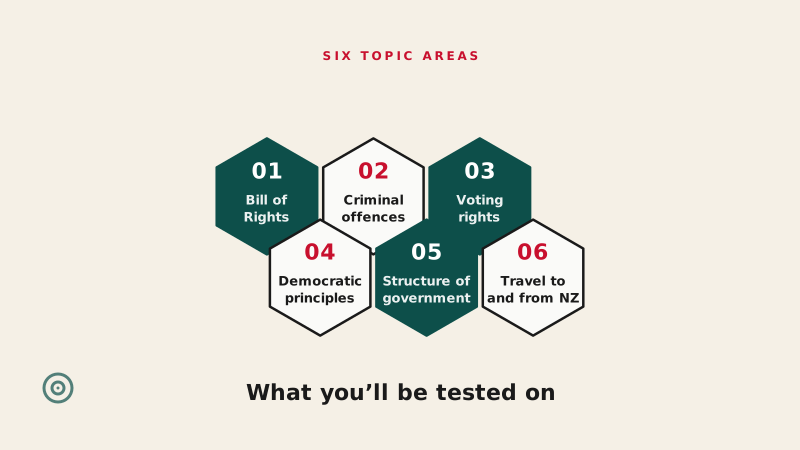
Each section below covers one of the six topic areas DIA has confirmed for the test. For each topic, you'll find:
- What the topic covers
- The key facts you should know
- Authoritative sources for deeper study
The detailed syllabus hasn't been published yet, so the specifics below are based on the confirmed topic areas plus what comparable Australian and UK tests typically cover. When DIA releases the official study materials, we'll update each section.
NZ legislation and government information is freely available online and is published under permissive licences. We've linked to the authoritative source for each topic — these are what to read if you want to study from the originals.
01 · The Bill of Rights Act
The New Zealand Bill of Rights Act 1990 is the central statute affirming civil and political rights for everyone in New Zealand. It's the most likely source of questions about what rights you have as a citizen.
What's protected
The Act affirms a recognisable set of civil and political rights, including:
- Freedom of expression — the right to seek, receive, and impart information and opinions
- Freedom of religion and belief — including the right to manifest religion or belief in worship, observance, practice, and teaching
- Freedom of assembly — the right to peaceful gathering
- Freedom of association — the right to associate with others
- Freedom from discrimination on grounds protected by the Human Rights Act, including race, sex, age, religion, disability, and sexual orientation
- The right to vote for citizens 18 and older in genuine periodic elections
- The right to a fair trial, including the presumption of innocence and the right to legal counsel
- The right to silence — protection against self-incrimination
- Freedom from torture or cruel treatment
- Freedom from arbitrary arrest or detention
- Freedom of movement, including the right to leave New Zealand and (for citizens) the right to enter
Important nuances
The Bill of Rights Act is not entrenched — meaning Parliament can pass other laws that override it. Where another law conflicts with the Bill of Rights Act, the courts must try to interpret the other law consistently with the Bill of Rights, but if that's not possible, the other law prevails. This is different from the constitutional bills of rights in countries like the US or Canada.
The Act also does not protect some rights you might expect:
- Property rights are not directly protected
- Social and economic rights (housing, health, education) are not framed as rights
- The right to bear arms — explicitly not a right in NZ law
Where to study
Read the full text at legislation.govt.nz: New Zealand Bill of Rights Act 1990. The Act is short by legal standards — under 30 sections — and the sections affirming rights are written in plain language.
02 · Certain criminal offences
DIA hasn't specified exactly which offences will be examinable. The phrase "certain criminal offences" most likely refers to baseline awareness of serious offences and their consequences rather than detailed knowledge of the Crimes Act. The test is checking that applicants understand what's against the law in NZ, not training them to be lawyers.
Likely focus areas
Based on what comparable tests cover:
- Family violence and child protection — these are emphasised in NZ government messaging and likely to appear
- Driving offences — drink-driving, driving without a licence, dangerous driving
- Theft and fraud — what counts as a serious offence
- Sexual offences — including the legal age of consent (16 in NZ)
- Drug offences — at least the basic distinction between possession, supply, and manufacture
- The consequences of crime — particularly that serious offences can affect immigration status, citizenship eligibility, and travel rights
Key principle
The most important concept here is probably the presumption of innocence and the rule that the prosecution must prove guilt beyond reasonable doubt — both of which are foundational to NZ criminal law and overlap with the Bill of Rights Act.
Where to study
The Crimes Act 1961 is the primary source, but it's a long and technical statute. For a more accessible overview, the Ministry of Justice website publishes plain-English material on the criminal law system.
03 · Voting rights
Voting is one of the most concrete civic rights in NZ — and one of the easier topics to study because the rules are clear and stable.
Key facts
- Voting age: 18 — the same as in most democracies, though there's been ongoing debate about lowering it to 16
- Who can vote: NZ citizens, plus permanent residents who have lived in NZ for at least 12 continuous months at some point — NZ is one of the few countries that lets non-citizen residents vote in general elections
- Enrolment: compulsory for everyone 18 and older who's eligible — but actually voting is voluntary
- Election frequency: general elections every 3 years (the term of Parliament)
- Local government elections: separately, every 3 years on a different cycle, by postal vote
- Two votes: in a general election, you cast one vote for an electorate candidate and one for a party (the party vote determines the overall composition of Parliament under MMP)
- Right to stand: 18 and older to stand as a candidate, with NZ citizenship required
Where to study
The Electoral Commission (elections.nz) publishes plain-English guides on how to enrol, how to vote, and how MMP works. The Electoral Act 1993 is the legal source.
04 · Democratic principles
This topic is more conceptual than factual — it covers the values and institutions that make NZ a democracy. Expect questions that ask you to identify what is or isn't a democratic principle, and to recognise foundational concepts.
Core principles
- Rule of law — everyone, including the government, is subject to the law and must follow it
- Equal rights — every person has the same legal rights regardless of race, sex, religion, sexual orientation, or background
- Free and fair elections — citizens choose their representatives through secret ballot at regular intervals
- Separation of powers — legislative (Parliament), executive (Cabinet and the public service), and judicial (the courts) are separate and check each other
- Free press — independent journalism and public access to information
- Freedom of speech — the right to express opinions, including criticism of the government
- Government accountability — through Parliament, the Auditor-General, the Ombudsman, and the Official Information Act
- Independent judiciary — judges are appointed and protected from political interference
- Peaceful transfer of power — when one government loses an election, it hands power to the next without resistance
The Treaty of Waitangi
DIA has not formally confirmed whether Treaty of Waitangi content will appear on the test. Given the Treaty's place in NZ's constitutional framework, it's likely to be touched on — perhaps under "democratic principles" or "structure of government" — but we don't know in what depth. The Treaty was signed in 1840 between the British Crown and Māori chiefs, and it has both English and Māori versions, with each carrying different meanings in some key provisions. Modern NZ law and policy treat the Treaty as a foundational document.
Where to study
The Parliament website's "How Parliament Works" section is a clear plain-English source. Te Ara — the Encyclopedia of New Zealand has good background articles on democracy and the Treaty.
05 · Structure of government
NZ has an unusual constitutional setup — a parliamentary monarchy with no written constitution, no upper house, and a proportional electoral system. This topic tests whether you understand how the system fits together.
The basics
- Head of state: the Monarch — currently King Charles III. New Zealand is a constitutional monarchy.
- The Governor-General: represents the Monarch in NZ, performs ceremonial duties, signs bills into law, and acts on the advice of ministers. The current Governor-General is appointed for a five-year term.
- The Prime Minister: head of government, leader of the largest party (or coalition) in Parliament. Not the head of state.
- Parliament: the House of Representatives, with 120 MPs (sometimes more, due to overhang seats), elected for three-year terms. NZ has a unicameral Parliament — there's no upper house. The Legislative Council was abolished in 1951.
- Cabinet: the executive branch — the Prime Minister and senior ministers, who run the government departments and propose most legislation.
- The courts: independent of Parliament and Cabinet, with the Supreme Court at the top (since 2004, when it replaced the Privy Council in London as NZ's final court of appeal).
The electoral system: MMP
NZ uses Mixed Member Proportional (MMP) representation, adopted in 1996. Under MMP:
- Each voter casts two votes: one for a local electorate candidate, one for a party.
- The party vote determines what proportion of seats each party gets in Parliament. A party generally needs 5% of the party vote (or one electorate seat) to enter Parliament.
- Most seats are filled by the local electorate winners. The remaining "list seats" are allocated to top up each party's total to match its share of the party vote.
- This usually produces coalition governments rather than single-party majorities.
Local government
Below central government, NZ has two main tiers of local government: regional councils (responsible for environmental management, transport, flood control) and territorial authorities (city councils and district councils, responsible for roads, water, libraries, parks, and most local services). Some areas have unitary authorities that combine both roles — Auckland Council is the largest example.
Where to study
The Parliament's Visit and Learn pages are clearly written. elections.nz has a good MMP explainer.
06 · Travel to and from New Zealand
This topic covers what citizenship means for travel — both the rights it gives you and the documents it requires.
Key facts
- NZ passport: issued by the Department of Internal Affairs. Valid for 10 years for adults, 5 years for children. NZ citizens are entitled to a NZ passport.
- Right to enter NZ: as a citizen, you have the unconditional right to enter NZ at any time, regardless of how long you've been overseas. Permanent residents can lose their re-entry right after extended absence; citizens cannot.
- Right to leave NZ: guaranteed under the Bill of Rights Act, except in narrow circumstances such as outstanding criminal charges or court orders.
- Dual citizenship: NZ allows dual or multiple citizenship. Becoming an NZ citizen does not require giving up your existing citizenship — though the country granting your other citizenship may have its own rules.
- NZeTA (Electronic Travel Authority): required for travellers to NZ from visa-waiver countries, but not required for NZ citizens entering NZ on an NZ passport.
- Australian citizens: have special travel and residence rights under the Trans-Tasman Travel Arrangement.
Where to study
The passports.govt.nz site covers passport applications. The Immigration NZ website covers entry rules and travel documents.
How to study effectively
- Don't try to memorise everything at once. Pick one topic per week, read the authoritative source, and write down the key facts in your own words. Repetition over weeks beats cramming.
- Practice with sample questions. Reading is necessary but not sufficient — multi-choice tests reward pattern recognition. Sample questions train you to spot what's being asked.
- Identify your weak topic. Most applicants find one or two topics harder than the others. Spend extra time on those rather than re-reading what you already know.
- Watch for the official study guide. When DIA publishes it, drop your other materials and use that as your primary source. It will tell you exactly what's examinable.
- Don't worry about Treaty content until DIA confirms. If the Treaty is on the test, DIA will publish the relevant material. Trying to study a topic that may or may not appear is inefficient.
What to do next
- Skim each of the authoritative sources linked above to get a feel for the material
- Read the complete guide to the test if you haven't already
- Check whether you might be exempt from the test
- If you'd rather skip the test entirely, see whether to apply before the cut-off
- Join our waitlist below to be notified when DIA publishes the official study guide and our practice platform launches
This article is general information drawn from publicly available sources, not legal advice. The official study materials and detailed syllabus have not yet been published by DIA — the specifics above are based on the confirmed topic areas plus what comparable tests typically cover. We'll update this article as DIA releases more detail.