The short answer
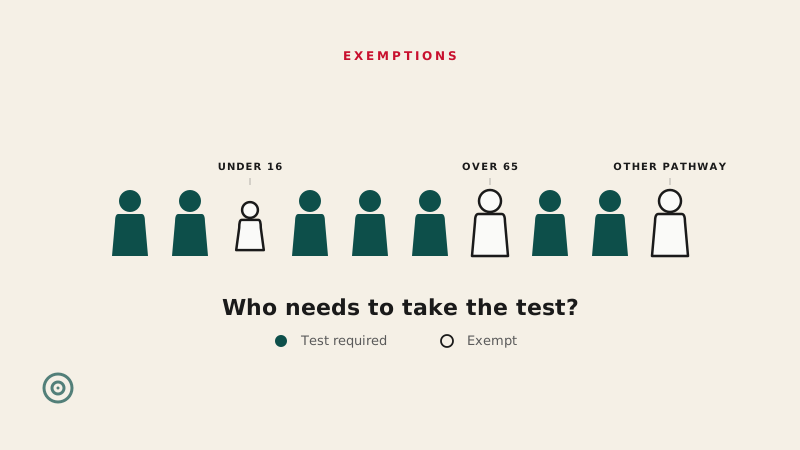
You don't need to take the new NZ citizenship test if any of the following apply:
- You'll be under 16 when you apply
- You'll be 65 or older when you apply
- You're getting citizenship by birth
- You're getting citizenship by descent
- You're using the Western Samoa pathway
- You apply before the test becomes a requirement in late 2027
- You qualify for one of the additional exemptions DIA is still detailing (likely covering significant disability or illness)
If none of these apply to you, you'll need to take the test as part of your citizenship application. The rest of this article walks through each category in detail, plus a self-check at the end.
The test only applies to citizenship by grant
New Zealand has three pathways to citizenship, and the new test only affects one of them:
- Citizenship by birth — for people born in NZ on or after 1 January 2006 to at least one parent who was a NZ citizen or permanent resident at the time. Different rules apply for people born before 2006. The test is irrelevant to this pathway.
- Citizenship by descent — for people born outside NZ to a NZ citizen parent. The test is irrelevant to this pathway.
- Citizenship by grant — for people who become eligible after living in NZ long enough as a resident. This is the only pathway affected by the new test.
If you're getting citizenship by birth or descent, the rest of this article doesn't apply to you — there's no test, and there never was one for those pathways.
Age-based exemptions
Applicants under 16
Children under 16 at the time of application are exempt from the test. This usually applies to children included in family applications alongside their parents. The exemption acknowledges that civic-knowledge testing of children isn't appropriate — they're not expected to have the same understanding of laws and government as adult applicants, and their citizenship typically follows from their parents' status anyway.
Applicants 65 and older
Applicants who are 65 or older when they apply are also exempt from the test. This brings NZ in line with both Australia (which exempts applicants over 60) and the UK (which exempts applicants over 65). The reasoning is partly about fairness — older applicants may have more difficulty with formal testing, particularly if English isn't their first language — and partly recognition that older migrants are often spouses or parents of established citizens, with strong existing ties to NZ.
If you'll turn 65 between now and when you'd otherwise apply, the relevant date is the date your application is submitted. If you submit on or after your 65th birthday, you're exempt. If you submit before, you're not.
Pathway-based exemptions
Citizenship by birth and descent
As covered above, neither pathway involves the test. If you qualify for citizenship by birth, you're already a citizen — you may need to prove it with a citizenship certificate, but there's no application involving a test. If you qualify by descent, you apply via a different process that has never involved a test and won't with the new requirement either.
The Western Samoa pathway
This is a unique NZ exemption worth understanding. People of Samoan heritage born between 1924 and 1948 (and their descendants, in some cases) can apply for citizenship under the Citizenship (Western Samoa) Act 1982. This pathway exists because of NZ's historical role as the administrator of Western Samoa under a League of Nations and later UN mandate from 1920 to 1962, and was created in response to the 1982 Lesa case in the Privy Council, which held that certain Samoans had been NZ citizens by birth.
The Western Samoa pathway has its own application process and does not involve the new citizenship test.
The cut-off date exemption
Anyone who applies for citizenship before the test becomes a requirement (the second half of 2027) doesn't need to take it. This includes applications already submitted and being processed when the test goes live — applications are assessed under the rules that applied when they were submitted, not when they're decided.
If you're already eligible to apply and want to skip the test entirely, see our decision guide on whether to apply now or wait — it walks through the timing, eligibility checks, and edge cases.
Likely additional exemptions
DIA has confirmed that other exemptions will be detailed before the test goes live, and has said exemption details will be communicated to applicants in advance. Based on how Australia and the UK handle similar tests, expect provisions for:
- Significant disability or illness that makes taking the test impossible or unreasonable. Australia has a "Special Consideration Test" with a simplified format; the UK accepts medical exemption certificates from a registered medical practitioner.
- Significant cognitive or learning impairments — usually with medical evidence required.
- Mental health conditions that would be aggravated by formal testing — handled case-by-case.
These are likely outcomes based on comparable systems, but they're not yet confirmed for NZ. The official list will come closer to launch.
If you have a disability that doesn't qualify you for full exemption, you may still be eligible for accommodations in how you take the test — extra time, screen reader support, sign language interpreters, or simplified-language formats. The procurement tender for the digital test platform mentions standard accessibility considerations, suggesting these will be available.
A self-check
Walk through these questions in order:
- Are you applying for citizenship by birth or descent? → If yes, no test required.
- Are you applying under the Western Samoa pathway? → If yes, no test required.
- Will you be under 16 or 65 or older when you apply? → If yes, no test required.
- Will you submit your application before the test becomes a requirement in late 2027? → If yes, no test required.
- If none of the above: you'll need to take the test, unless you qualify for one of the additional exemptions DIA is still detailing.
What we still don't know
- The exact medical and disability exemption criteria
- What evidence will be required to qualify (a single medical certificate? specialist assessment?)
- Whether there's an appeal process for refused exemption applications
- Whether accommodations need to be requested in advance, or whether they can be arranged on the day
- Whether there are other exemption categories DIA hasn't yet flagged publicly
We'll update this article as DIA publishes more detail.
What to do next
- If you might be exempt — confirm using the self-check above, then watch for DIA's official exemption guidance closer to launch
- If you have a disability or illness that might qualify you for exemption or accommodation, start gathering medical documentation now so you're ready when the application process opens
- If you're not exempt, read how the test works for what to expect on test day
- If you're already eligible to apply, see whether applying before the cut-off makes sense for your situation
- Join our waitlist below for the official study guide and our practice platform
This article is general information, not legal or immigration advice. Exemption rules are being finalised by DIA and final criteria may differ from what's described here. For your specific situation — especially if you have a disability, complex family circumstances, or are considering the Western Samoa pathway — consult a licensed immigration adviser or DIA directly.